
Probability — Question Ex 15.1 Q25
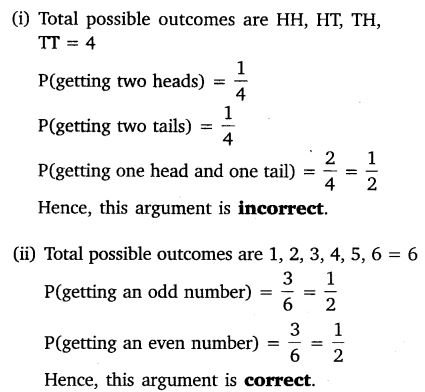
Back to all questionsWhich of the following arguments are correct and which are not correct? Give reasons for your answer.
(i) If two coins are tossed simultaneously there are three possible outcomes- two heads, two tails or one of each. Therefore, for each of these outcomes, the probability is \(\frac { 1 }{ 3 }\).
(ii) If a die is thrown, there are two possible outcomes- an odd number or an even number. Therefore, the probability of getting an odd number is \(\frac { 1 }{ 2 }\).

CBSE Class 10 Probability — Complete Guide
Probability is an easy-to-score chapter worth 4-5 marks. Classical probability with coins, dice, cards, and bags.
Quick Revision: Key Concepts
- P(E) = favourable / total outcomes
- Complementary: P(E) + P(not E) = 1
- Range: 0 ≤ P(E) ≤ 1
- Cards: 52 total, 4 suits, 12 face cards, 26 red, 26 black
Most Important Questions
- Coin and dice probability problems
- Playing card probability (specific suit, face card, etc.)
- Balls in a bag problems
- Number/divisibility probability problems
About Bright Tutorials
Bright Tutorials, Hariom Nagar, Nashik Road, provides expert coaching for CBSE and ICSE students. Our experienced faculty ensures comprehensive preparation for board exams with personalised attention and 3-tier differentiation for students of all levels. Contact us at 9403781999 or visit brighttutorials.in.